

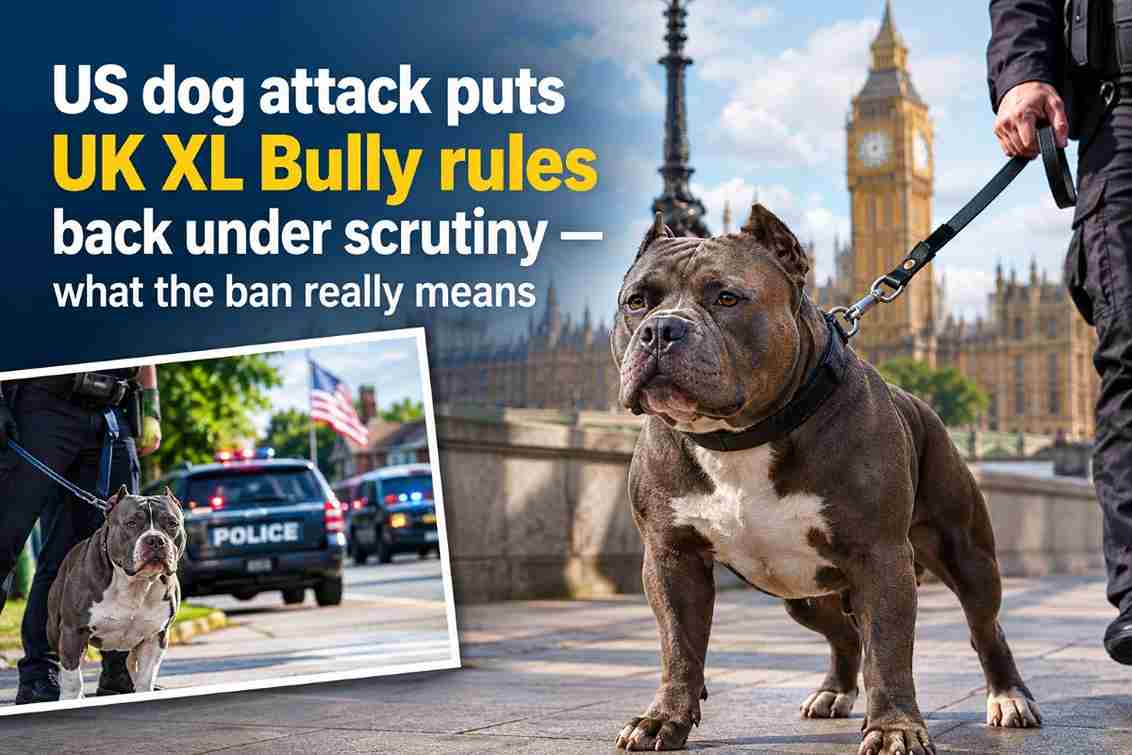
A woman is fighting for her life after a severe dog attack in San Francisco, an incident that has reignited debate about powerful bully-type dogs and whether Britain’s approach is doing enough to protect the public. But the US case does not mean the UK’s XL Bully ban has failed — or that every large, muscular dog is covered by the legislation.
What’s actually true
The latest US incident happened in San Francisco’s Tenderloin district, where police said a woman suffered life-threatening injuries after being attacked by an unleashed pit bull. Officers found the dog near the injured woman and restrained it; she was taken to hospital with traumatic injuries. Authorities are still investigating the circumstances. (SFGATE)
That distinction matters when the story is discussed alongside Britain’s XL Bully restrictions. A pit bull in the United States is not automatically an XL Bully under UK law, and the two legal systems use different definitions and enforcement arrangements.
In England and Wales, XL Bully dogs are prohibited under the Dangerous Dogs Act unless they have a valid Certificate of Exemption. Owners of exempt dogs must comply with strict conditions, including keeping them muzzled and on a lead in public and preventing them from escaping.
The law also goes beyond XL Bullies. It is illegal to allow any dog to be dangerously out of control, whether in a public place or on private property. If a dog injures someone, its owner or keeper can face serious criminal consequences.
How this connects to the UK XL Bully ban
The renewed scrutiny is really about a broader question: does regulating a particular dog type prevent dangerous attacks, or should the focus be on individual dogs and irresponsible owners?
That debate remains unresolved. The Government introduced the XL Bully restrictions following concerns over serious and fatal attacks, while critics of breed-specific legislation have argued that dangerous-dog laws should concentrate more heavily on behaviour and responsible ownership.
There has also been continued government attention to how the existing ban works. In March 2026, ministers published a response to the Animal Sentience Committee’s report on XL Bullies and the Dangerous Dogs Act.
Meanwhile, the rules are still evolving. From 1 November 2026, owners of exempt banned dogs in England and Wales will have an additional condition: children under 12 must not be left in close contact with the dog in a private setting without adult supervision.
Common misconceptions about the ban
One common assumption is that the XL Bully ban means all large or muscular dogs are illegal. That is not correct. The legislation applies to a defined type, assessed against the Government’s conformation standard, rather than simply banning dogs because they look big or intimidating.
Another misconception is that an exempt XL Bully can be treated like an ordinary pet. It cannot. Owners must continue meeting the legal conditions attached to the exemption.
It is also wrong to assume that a dog attack involving a different breed has no relevance to Britain’s policy debate. The wider issue is how governments balance breed-specific restrictions with laws that hold owners responsible when dogs become dangerously out of control.
What to do next
For ordinary dog owners, the practical lesson is straightforward: do not rely on breed labels alone when assessing risk.
Keep dogs under effective control, particularly around children and unfamiliar people. If you own a dog covered by Britain’s banned-dog rules, check the latest official requirements rather than relying on social-media posts or older articles.
If you believe a dog may be dangerously out of control, report the situation to the appropriate police or local authority. In an immediate emergency, call 999.
Owners of dogs that may fall within the XL Bully definition should also check the current GOV.UK guidance before taking any action, because requirements and enforcement arrangements can change.
Key takeaways
The San Francisco attack is a serious reminder of the potential consequences of poorly controlled powerful dogs, but it does not by itself prove that Britain’s XL Bully policy works or fails.
What is clear is that England and Wales already have strict restrictions on XL Bully ownership, while dangerous-dog laws apply to every breed. The debate now is increasingly about whether those measures provide the right balance between public safety, responsible ownership and breed-specific regulation.